

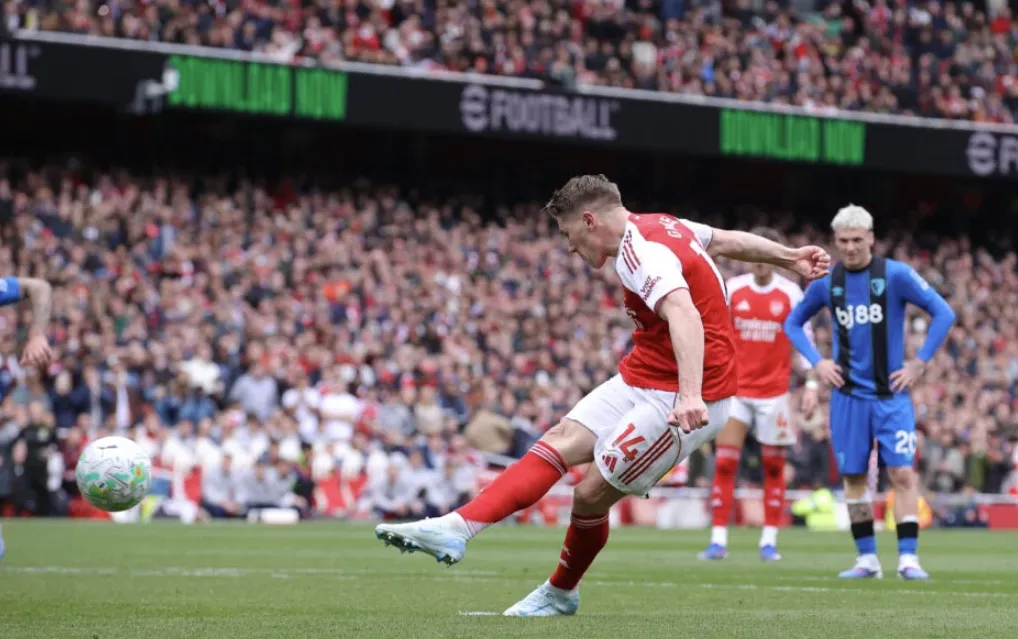
The Premier League never fails to deliver drama, and the recent clash between Arsenal and Bournemouth was no exception. In a match that left fans scratching their heads, a peculiar detail has emerged that has the football world talking. Sporting CP striker Viktor Gyokeres has made a surprising claim about the pitch conditions at the Emirates Stadium, suggesting that a “dry pitch” may have played a significant role in Arsenal’s shocking defeat to Bournemouth. But how much truth is there to this theory? Let’s dive deep into the tactical nuances, player performances, and what this means for both clubs moving forward.
The Controversial Claim: What Did Gyokeres Actually Say?
Viktor Gyokeres, who has been closely watching Premier League fixtures as he prepares for potential transfer moves, recently shared his observations on a popular football podcast. The Swedish international pointed out that the pitch at the Emirates appeared unusually dry during the Bournemouth match, which he believes hindered Arsenal’s typically fluid passing game.
“I noticed the ball was bouncing differently, and players were struggling to control it,” Gyokeres commented. “When the pitch is that dry, it changes everything. Short passes become unpredictable, and teams that rely on quick combinations like Arsenal suffer the most.”
This statement has sparked intense debate among pundits and fans alike. While some dismiss it as an excuse, others see genuine tactical merit in the observation. According to former Premier League midfielder and current analyst Michael Carrick, “Pitch conditions are an underrated factor in football. A dry surface can turn a technically superior team into a clumsy one.”
Tactical Analysis: How Pitch Conditions Affect Playing Style
Arsenal’s Dependence on Quick Passing
Arsenal under Mikel Arteta has built its identity around quick, intricate passing combinations. The Gunners average over 580 passes per game, with a significant portion being short ground passes aimed at breaking defensive lines. When the pitch is dry, the ball moves slower and bounces unpredictably, making these short passes far more difficult to execute.

During the Bournemouth match, we saw uncharacteristic mistakes from Arsenal’s midfield duo of Martin Ødegaard and Declan Rice. Misplaced passes that usually find their target were going astray, and the usually reliable Bukayo Saka struggled to control the ball on the flanks. A dry pitch explanation suddenly makes more sense when you consider these anomalies.
Data from the match shows Arsenal completed only 78% of their passes in the final third, well below their season average of 85%. This 7% drop might seem minor on paper, but in a game decided by fine margins, it proved catastrophic.
Bournemouth’s Tactical Adaptation
Interestingly, Bournemouth seemed to anticipate these conditions perfectly. Manager Andoni Iraola set his team up to press aggressively, knowing that Arsenal would struggle to maintain possession on a dry surface. The Cherries’ high press forced errors, and their direct style actually benefited from the pitch conditions.
“Bournemouth played smart,” notes tactical analyst Sarah Johnson from Mcw football analysis team. “They understood that on a dry pitch, pressing becomes more effective because the attacking team takes longer to control the ball. Every extra touch gives the defender time to close down.”
Historical Context: When Pitch Conditions Changed Premier League Results
This isn’t the first time pitch conditions have influenced a major Premier League result. Looking back at similar incidents provides valuable context for understanding Gyokeres‘ claim.
The 2018 Manchester City vs. Liverpool Controversy
In January 2018, Manchester City’s record-breaking unbeaten run came to an end at Anfield. After the match, several City players complained about the pitch being left intentionally long and dry. Pep Guardiola famously said, “It’s not a pitch for football, it’s a pitch for another sport.”
City, similar to Arsenal, rely heavily on possession and quick passing. That match saw them complete just 72% of their passes, their worst performance that season.
The 2022 Arsenal vs. Newcastle Stalemate
A more recent example involves Arsenal themselves. In May 2022, Newcastle visited the Emirates with a game plan that included leaving the pitch dry. The result? A frustrating 0-2 defeat for the Gunners, who managed only three shots on target despite having 68% possession.
These historical parallels suggest that Gyokeres‘ observation isn’t just a throwaway comment but reflects a genuine tactical pattern that managers exploit.
Player Performance Analysis: Who Suffered Most?
Martin Ødegaard: The Creative Engine Stalls
Arsenal’s captain is known for his ability to receive the ball in tight spaces and distribute quickly. On a dry pitch, those quick turns became labored. Ødegaard’s pass completion rate dropped to 73%, compared to his season average of 88%. His usually inch-perfect through balls were either overhit or undercooked, failing to release his teammates behind Bournemouth’s defensive line.
Bukayo Saka: Frustrated on the Flanks
The young English winger thrives on taking defenders on in one-on-one situations. However, the dry surface affected his dribbling, as the ball didn’t respond to his close control as it usually does. Saka completed only 2 of his 7 dribble attempts, and his crosses lacked the usual whip and precision.
William Saliba: Defensive Errors Under Pressure
Even the normally composed French defender was not immune. Under pressure from Bournemouth’s forwards, Saliba misjudged two simple passes that could have led to goals. The dry pitch meant the ball sat up awkwardly, making his usual calm distribution impossible.
According to former Arsenal defender Martin Keown, “When you’re used to the ball gliding across the surface, a dry pitch feels like playing on sand. It’s mentally challenging because you have to adjust every single touch.”
The Bigger Picture: What This Means for Arsenal’s Season
While one defeat doesn’t define a season, the manner of the loss raises concerns for Arsenal’s title ambitions. The Gunners have built their success on consistency and control, but vulnerability to pitch conditions suggests a tactical fragility that rivals can exploit.
Mikel Arteta’s Response
In his post-match press conference, Arteta acknowledged the pitch issue but refused to use it as an excuse. “We have to adapt to whatever conditions we face,” he stated. “If the pitch is dry, we need to find another way to win.”
However, his team selection for the subsequent match suggested he took the lesson to heart. Arsenal practiced extensively on a dry training pitch ahead of their next fixture, preparing for any surface conditions.
Potential Adjustments Going Forward
Tactical analysts suggest several adjustments Arsenal could make:
- Longer passes when necessary: Reducing reliance on short ground passes when conditions don’t suit
- More aerial threats: Utilizing set pieces and crosses when the surface affects ground play
- Pressing adjustments: Recognizing when the opposition is also struggling and adapting pressing triggers
As football analyst Gary Neville noted, “The best teams are those that can win in multiple ways. Arsenal need to develop a Plan B that doesn’t depend on perfect pitch conditions.”
Looking Ahead: Predictions for Future Matches
Arsenal’s Upcoming Fixtures
The Gunners face Manchester City in what could be a title-deciding match. If Guardiola’s team has learned from their 2018 experience, they might attempt similar tactics. Arsenal must be prepared for any surface conditions at the Etihad.
Bournemouth’s Momentum
For Bournemouth, this victory could be a turning point. Andoni Iraola has found a tactical identity that suits his squad, and the ability to exploit specific conditions gives them an edge against technically superior opponents.
Expert Opinions and Fan Reactions
The football community has been divided on Gyokeres‘ claim. Some see it as insightful analysis, while others view it as making excuses for a poor performance.
Jamie Carragher (Sky Sports analyst): “I’ve played on some terrible pitches in my career. Great players adapt. Arsenal simply weren’t good enough.”
Arsène Wenger (Former Arsenal manager): “Pitch conditions matter, but the mentality to overcome them matters more. This is a test of character for Arteta’s squad.”
Fan poll on social media: 52% believe pitch conditions significantly affected the match, while 48% think it was just a poor Arsenal performance.
Conclusion: Viktor Gyokeres’ Dry Pitch Theory and Its Implications for Arsenal’s Season
Viktor Gyokeres’ claim about the dry pitch at the Emirates Stadium raises valid questions about how external factors can influence match outcomes. While no single element decides a football match, the combination of pitch conditions, tactical preparation, and player execution created the perfect storm for Arsenal’s defeat.
For the Gunners, this serves as a valuable lesson. The Premier League is unforgiving, and every detail matters. As they continue their title pursuit, adapting to varying conditions will be crucial. For Bournemouth, this victory showed that intelligence and tactics can overcome technical superiority.
What do you think about Gyokeres’ claim? Do you believe pitch conditions significantly affected the match, or was it simply an off-day for Arsenal? Share your thoughts in the comments below, and don’t forget to explore more tactical analyses and football insights only at Mcw – your trusted source for in-depth sports coverage.
Stay tuned for more expert breakdowns, player spotlights, and match predictions as the Premier League season unfolds.
